
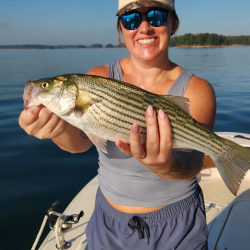
October fishing is all about being versatile. Turnover has started early, stripers are beginning to break out of their south-end summer pattern, and fish are showing up above the GA Highway 369 bridge. Anglers should be prepared to move between topwater, casting, vertical presentations, flatlines, and downlines as the fish and bait move throughout the day.
Turnover will continue to influence water clarity and fish location throughout October. Below GA Highway 369, schools may explode on the surface during the first few hours and last couple of hours of the day, especially with cloud cover. Some fish have already moved north of the bridge, where they have historically been less likely to come up consistently. That could be different this year because more fish stayed farther north than normal during the summer.
How the Pattern Will Change This Month
Expect the pattern to change during the day. Surface-feeding fish may quickly drop back down, and schools holding 30–40 feet deep over 60–100 feet of water should remain a dependable target throughout the month.
Where Fish Will Set Up
Focus on:
Surface-feeding schools below the GA Highway 369 bridge early and late in the day
Main-lake and creek pockets where stripers are pushing bait toward the surface
Fish holding 30–40 feet deep over 60–100 feet of water
Schools moving north of GA Highway 369 as the fall transition continues
Use your Humminbird APEX to follow the school after the surface activity ends. A school that disappears from the top may still be directly under the boat and available to a spoon, Mini Mack, or downlined bait.
What Will Work Consistently
Jr. HAWG Spoon
The Jr. HAWG is a versatile choice for October. Fish nickel or nickel/silver scale on sunny days and pearl or pearl/blue scale on cloudy days. Work it near the surface like a Magic Swimmer when fish are up, let it fall and yo-yo it back after the school goes down, or fish it vertically when the school moves under the boat.
Vertical power reeling
When fish show beneath the boat, drop the Jr. HAWG about 20 feet below the depth you are marking and power reel it back through the school just as you would a Boss HAWG. The thinner Jr. HAWG casts better than the wider Fat HAWG, although the Fat HAWG will catching fish.
Mini Macks
A Mini Mack is another strong choice for schooling fish. Be ready because fired-up stripers may produce more than one fish at a time.
Flatlined herring
When fish are surfacing in a pocket, keep a flatlined herring 75–100 feet behind the boat while you chase the school with the trolling motor. These fish move quickly, and a herring pulled a couple of miles per hour behind the boat can draw a bite from fish you have just passed over.
Downlined herring or small shad
Target schools holding 30–40 feet deep over 60–100 feet of water. Shorten your leader to 5–6 feet of 10-pound fluorocarbon and use a No. 2 Gamakatsu circle hook so the bait does not have to work too hard.
What Will Stop Working
Relying on only one presentation
October fish may be on the surface one minute and back below the boat the next. Keep casting, vertical, live-bait, and trolling options ready so you can adjust without losing the school.
Leaving when the surface bite ends
A school that stops breaking the surface may still be beneath the boat. Check your electronics before moving and be ready to yo-yo a spoon, power reel, or drop live bait through the fish.
Using summer leaders
As conditions change, shorten downline leaders to 5–6 feet while staying with 10-pound fluorocarbon and a No. 2 circle hook.
Fishing only the south end
Stripers are beginning to move above GA Highway 369. Continue checking the traditional south-end areas, but do not overlook fish that have already pushed farther north.
Key Takeaways for Anglers
Be ready to switch between topwater, casting, vertical presentations, flatlines, and downlines.
Look for surface activity below GA Highway 369 early and late, especially with cloud cover.
Follow surface schools on your electronics after they go down.
Use a Jr. HAWG Spoon near the surface, yo-yoed through the water column, or power reeled vertically.
Keep a flatlined herring 75–100 feet behind the boat while chasing fish in pockets.
Target deeper schools 30–40 feet down over 60–100 feet of water with herring or small shad.
Shorten live-bait leaders to 5–6 feet of 10-pound fluorocarbon with a No. 2 circle hook.
What to Expect Heading Into November
As turnover continues and water temperatures fall, keep following the bait and watching how the fish respond. The best location and presentation may change quickly, so use your electronics and surface activity to decide whether to cast, fish vertically, pull a flatline, or drop live bait.
Captain Ron’s Final Thoughts
October rewards anglers who are prepared to change with the fish. Keep several rods rigged, watch the surface, and use your electronics to stay with the school after it goes down. If you can move quickly from one presentation to another, you can keep catching fish as the lake turns over and the fall pattern develops. Get out there and catch them up!
Captain Ron’s Note
“If you declare with your mouth, ‘Jesus is Lord,’ and believe in your heart that God raised him from the dead, you will be saved.”
Romans 10:9